

From unconscious behavior to conscious creation—and why the journey never really ends.
Unphuck Yourself
Have you ever looked back at something you've said or done and thought, "What the phuck was I thinking?" Congratulations! That's awareness knocking at the door. The question is, how long did it take to arrive?
Did you recognize your behavior immediately? Halfway through? Three days later while replaying the conversation in your head? Or are you still convinced that the other person was entirely responsible for what happened?
The answer tells you something about your current level of conscious awareness.
Over the years, I've come to recognize five distinct stages in the process of awakening, which I affectionately call The Levels of Phuckedness.
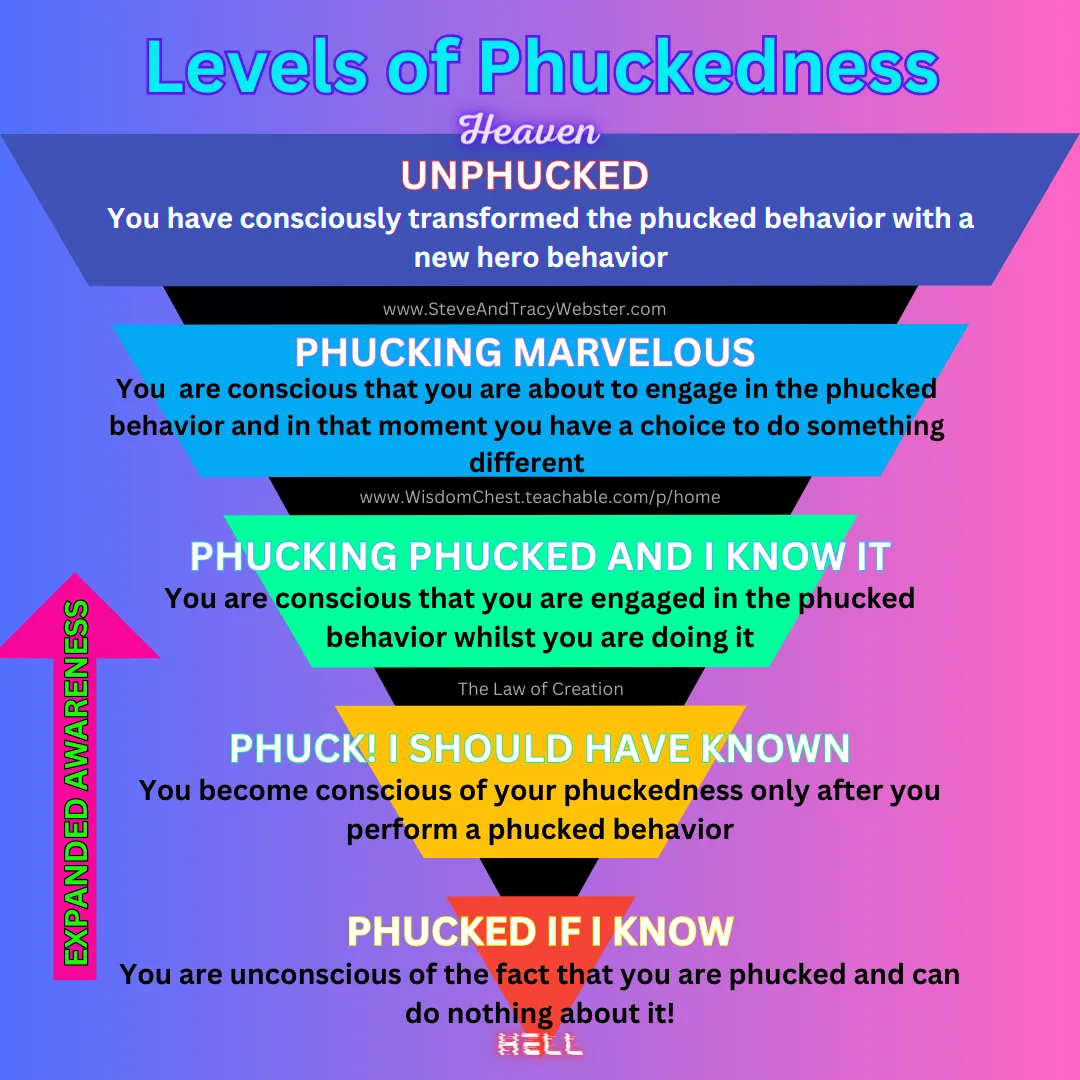
Each stage represents an expansion in your ability to observe your thoughts, recognize your behavioral patterns, and consciously choose how you respond to life.
And here's the funny thing: just when you think you've reached the top, the Universe presents another opportunity to discover something new about yourself.
Let's explore how it works.
Level 1: Phucked If I Know
Unconscious Behavior — Living on Autopilot
Welcome to Level 1, where you're completely unaware of how phucked you are!
At this stage, you're living unconsciously, unaware of who you truly are, why you're here, or how much of your experience is being shaped by your own beliefs, perceptions, and habitual responses.
Life appears to be happening to you, and there's usually someone or something responsible for your unhappiness. It's your parents' fault. Your spouse's fault. Your boss's fault. The government's fault. The virus, the bacteria, the economy, or that idiot who cut you off in traffic. There's always a reason why life isn't working, and that reason is conveniently located somewhere outside yourself.
You become very good at explaining why you're unhappy while continuing to participate in the very patterns that keep you there. I call this being happy being unhappy. And, in hindsight, I sometimes think this stage is relative bliss! Haha. After all, when you're unaware of your own participation in the experience, there's very little responsibility to take for changing it.
The problem is that you can spend an entire lifetime waiting for the world to change so that you can finally feel better.
An Everyday Example: Imagine you're constantly complaining about your relationship. "My partner never listens to me. They always make me angry. They don't appreciate anything I do." Every disagreement reinforces the same conclusion: your relationship would be wonderful if only your partner would change.
What remains outside your awareness is your own contribution to the dynamic—the expectations, reactions, assumptions, and communication patterns you bring into every interaction. And because you cannot yet see your own behavior, you have no reason to question it.
What Moves You Forward? For many people, awakening begins with a significant disruption. A relationship ends. You lose a job. You experience illness, grief, betrayal, or some other event that shakes the foundations of everything you thought you knew.
Something comes along and gives you a great big cosmic slap!
Suddenly, the old explanations no longer satisfy you, and you begin asking different questions. Why does this keep happening? Why do I keep attracting the same experiences? What if there's something about my own behavior that I haven't recognized?
These questions are the beginning of awareness. You generally resist change until the fear of staying the same exceeds the fear of changing.
And that's when your journey begins.
Practical Tip: Become Curious. The next time something goes wrong, notice where the blame goes. Before deciding who or what is responsible, ask:
"What am I believing about this situation, and how is that belief influencing my experience?"
There's no requirement to find an answer immediately. The purpose is simply to introduce a new possibility into your awareness. The moment you begin questioning your automatic interpretations, you've already started moving toward Level 2.
Level 2: Phuck! I Should Have Known
Retrospective Awareness — Recognizing the Pattern After the Event
At Level 2, something wonderful and incredibly frustrating begins to happen. You recognize your own phucked behavior! Unfortunately, you usually recognize it after you've finished doing it. You've snapped at your partner, criticized your children, reacted defensively to a comment, or spent an entire afternoon worrying about something that hasn't happened.
And then, sometimes minutes or even hours later, the realization arrives.
"Phuck! I did it again!"
Welcome to conscious awareness in hindsight.
This stage can be particularly frustrating because you genuinely want to change. You've identified a pattern that no longer serves you, and you've decided to behave differently. Yet, despite your best intentions, you keep repeating it.
Why?
Because habitual behavior has been reinforced through repetition. Your brain becomes efficient at running familiar responses, especially when emotion is involved.
Changing a habit requires more than deciding to behave differently. You need to recognize the triggers, practice alternative responses, and repeat those responses until they become increasingly familiar and accessible.
This involves neuroplasticity—the brain's capacity to reorganize and strengthen neural connections through experience and practice. Every time you consciously rehearse and repeat a new behavior, you support the development of a new habitual response.
An Everyday Example
Let's say you've decided to stop reacting defensively whenever someone criticizes you. You've read the books. You've listened to the podcasts. You've made a solemn declaration that from now on, you're going to respond calmly. Then your partner says, "You never put anything away."
And off you go!
"Well, perhaps if you didn't leave your stuff everywhere..."
Twenty minutes later, after a spectacular exchange of accusations, you suddenly remember your intention. "Phuck! I was supposed to stay calm!"
The important development is that you've recognized the behavior as your own. Previously, you might have spent the rest of the day explaining why your partner deserved your reaction. Now you're beginning to recognize that you have a choice in how you respond.
Your awareness has expanded, even though your behavior hasn't caught up yet.
Practical Tip: Review Without Judgment
At the end of each day, think back to one moment when an old behavior appeared. Ask yourself three questions:
What triggered my reaction?
What was I thinking or believing at that moment?
How would I prefer to respond next time?
Then mentally rehearse the new response. The purpose is to become familiar with the pattern so that you can recognize it earlier the next time it appears. And eventually, something rather marvelous happens. You catch yourself in the act!
Level 3: Phucking Phucked and I Know It
Present-Moment Awareness — Recognizing the Pattern While It's Happening
This is where awakening starts getting interesting. At Level 3, you begin recognizing your behavior while you're actually engaged in it. You're halfway through an argument when a thought suddenly appears:
"Hang on. I'm doing that thing again!"
For the first time, you're consciously observing your behavior as it's happening. This is a significant development because the present moment is where your choices become available. You may still be angry, defensive, frightened, or judgmental, but you're beginning to recognize the familiar pattern while it's in motion. You can see what you're doing, and you're starting to understand why you're doing it.
And then something else happens.
You start recognizing everyone else's phucked behavior too!
Oh, this is a fascinating stage. Suddenly, you can see the unconscious patterns operating in your friends, family, colleagues, and complete strangers. You recognize their fears, their defensive reactions, their limiting beliefs, and their tendency to blame the world for their experiences. And naturally, because you've discovered something that has helped you, you want to share your newfound wisdom.
So you set off on a mission to fix everyone!
You explain why their thinking is wrong. You recommend books, courses, meditation, and spiritual practices. You offer unsolicited insights into their childhood conditioning. All with the very best of intentions, of course.
There's just one small problem.
You're still trying to change something outside yourself in order to feel better inside yourself.
You've simply exchanged one form of external control for another.
At Level 1, you wanted people to change because they were responsible for your unhappiness. At Level 3, you want people to change because you've decided that you understand what is wrong with them. And because you genuinely believe you're helping, the pattern can be difficult to recognize.
The question to ask ourselves is: Who am I to decide that someone else's journey should look like mine?
When you identify another person's perspective as wrong and attempt to correct it, you're still participating in the duality of right and wrong. You're still seeing something outside yourself that you believe needs fixing.
And that realization becomes the doorway to Level 4.
An Everyday Example
Imagine you've become conscious of how damaging constant complaining can be to your emotional state. You begin practicing gratitude and discover that your entire experience of life starts changing. Wonderful! Then you visit a friend who spends the afternoon complaining about everything.
You immediately recognize the pattern.
So you explain how their negative thinking is creating their unhappiness. You encourage them to be grateful, recommend a book, and explain how much better life would be if they changed their attitude.
Your friend becomes defensive.
You become frustrated.
And suddenly, you're both participating in the very behavior you were trying to eliminate.
The mirror is doing its job beautifully!
Practical Tip: Observe the Urge to Fix
The next time you feel compelled to correct someone's thinking or behavior, pause and ask:
"What is it about this person's behavior that I am finding difficult to accept?"
Then consider:
"What would change in my experience if I allowed this person to be exactly as they are?"
This is where your attention begins turning inward.
And that changes everything.
Level 4: Phucking Marvelous
Conscious Choice — Changing the Self and Experiencing a Different Reflection
At Level 4, you begin understanding how to work consciously with your own state of BEing. You've recognized your patterns. You've learned to observe them while they're happening. You've begun understanding the beliefs and emotions that sustain them.
Now you're ready to do something different.
You stop attempting to rearrange the outside world and turn your attention inward. You recognize that your experience of others is inseparable from the perspective through which you're observing them. When you change your beliefs, expectations, emotional responses, and behavior, your experience of the same circumstances can change dramatically.
The mirror changes because the observer has changed. This is where you begin consciously applying what you've learned. Rather than waiting for someone to behave differently before you can feel peaceful, you choose peace within yourself. Rather than demanding understanding, you practice understanding. Rather than reacting to a familiar trigger, you recognize the response forming and consciously choose another.
And through repetition, the new behavior becomes increasingly natural.
An Everyday Example
Let's return to your friend who constantly complains. Previously, their behavior irritated you. You felt compelled to correct them, and their resistance only increased your frustration.
Now you approach the interaction differently. You recognize that their perspective belongs to them, just as yours belongs to you. You listen without feeling responsible for changing their experience. You might share your own perspective if invited, but you no longer require them to agree with you.
And something interesting happens. The conversation feels different.
Perhaps your friend becomes more relaxed because they no longer feel judged. Perhaps they continue complaining exactly as before. Either way, your experience has changed because your relationship with the behavior has changed. You've stopped giving the external circumstance authority over your internal state.
This is conscious choice in action.
Practical Tip: Rehearse the New State of BEing
Before entering a situation that usually triggers an old response, take a moment to decide how you want to BE.
Ask:
"What state of BEing would I like to bring into this experience?"
Perhaps it's patience, compassion, confidence, curiosity, or calm. Feel into that state and consciously practice responding from it. Then repeat. Each repetition strengthens your familiarity with the new behavior, making it easier to access when the old pattern appears. Eventually, you discover that the situation which once triggered you no longer has the same effect.
Level 5: Unphucked
Conscious Integration — Peace, Acceptance, and Freedom
Ahhh. Heaven!
You've reached the point where the behavior that once caused you so much frustration no longer controls your experience. You've recognized it, understood it, consciously changed your response, and practiced that new behavior until it has become your natural way of BEing.
There's a wonderful sense of satisfaction and relief. You no longer feel the need to push against the situation, defend your position, or convince anyone else to change. You can simply allow life to unfold while remaining conscious of how you choose to participate.
And perhaps the greatest gift of this stage is the realization that everything can be exactly as it is, and you can be at peace with it.
There's nothing to prove. Nobody to fix. No argument to win. No requirement for the world to agree with your perspective. You experience the freedom of allowing others to be who they are while remaining sovereign in your own choices.
An Everyday Example
Remember the partner who used to trigger your defensive reactions? One day, they make the same comment that previously would have started an argument.
And you notice something remarkable.
Nothing happens.
There's no surge of defensiveness. No internal rehearsal of the perfect comeback. No desperate need to explain why they're wrong. You hear the comment, consider whether there's anything useful in it, and respond naturally.
Perhaps you laugh. Perhaps you agree. Perhaps you simply continue with your day.
The old emotional charge has dissolved. And with it, the need to repeat the old behavior.
Practical Tip: Recognize and Appreciate the Change
When you encounter a situation that once triggered you and discover that your response has changed, take a moment to acknowledge it. Notice how the experience feels in your body. Recognize the freedom of responding consciously. Appreciate the work that brought you here.
Gratitude helps reinforce your awareness of the new experience and encourages you to continue practicing it.
Enjoy the peace.
You've earned it!
And Then... You Get Phucked Again!
Here's the wonderful cosmic joke.
Just when you think you've finally got everything figured out, life presents you with another opportunity to expand your awareness. A new relationship. A different challenge. An unexpected event. A belief you didn't even realize you were holding.
And suddenly, you're back at Level 1, completely unaware of the next pattern waiting to be discovered.
Because awakening is a continuous process of evolution.
You don't necessarily move through these stages in a neat, permanent sequence. You may be at Level 5 in one area of life while operating at Level 2 in another. You may even move between stages within a single conversation!
The important thing is that every cycle expands your capacity for awareness.
Each time you recognize a pattern, understand its origins, and consciously choose a new response, you gain another degree of freedom. And with that freedom comes a different experience of yourself and the world. That's the beautiful thing about conscious evolution.
There is always more of yourself to discover.
So, how phucked are you? Perhaps the better question is:
How conscious are you of your phuckedness?
Because the moment you become aware of a pattern, you've already begun the process of changing your relationship with it.
And that, my friends, is how you begin to UnPhuck Yourself.
Quin Webster
Explore more in UnPhuck! Yourself and discover the practical process of conscious transformation at:
https://living-as-if.com/books/unphuck-yourself
Questions and answers
What are the five stages of spiritual awakening, and how do you move through them?
The five stages of awakening are unconscious behavior, retrospective awareness, present-moment awareness, conscious choice, and conscious integration. You progress by recognizing your habitual patterns, understanding what triggers them, and practicing new responses. As your awareness expands, you move from blaming external circumstances to consciously choosing your own state of BEing. Awakening is an ongoing process, with each new experience offering another opportunity for personal growth.