How Fucked Are You
The mind begins favouring information that reinforces its existing understanding of reality. This is how conditioning protects itself. We develop an attachment to being right because agreement feels rewarding. We resist alternative perspectives because disagreement threatens the familiar emotional state associated with our beliefs.
This world is an incredible place, filled with miracles that occur so routinely we barely recognize them. Yet our ability to perceive these miracles is limited by the very conditioning through which we experience reality.
To understand the world differently, we must undergo a metamorphosis of sorts. We must be willing to examine and undo the programming we've accumulated since birth, questioning everything we've been taught to believe about ourselves, our identities, and the nature of reality itself.
The world we see is a reflection of the beliefs through which we interpret it. Quantum discoveries have opened extraordinary conversations about the nature of reality, giving us new ways to explore questions that spiritual traditions have contemplated for thousands of years.
What if everything we believe to be true is simply a conditioned interpretation of reality? What if the world is far more incredible than we've ever allowed ourselves to imagine?
Consider the possibility that God exists within us. If we are expressions of God, what does that suggest about our potential? About the limitations we accept? About our ability to consciously participate in creating the lives we experience?
These questions invite us to reconsider the very foundations of our existence. And that requires a willingness to challenge ourselves.
Stop lying to yourself. Stop pulling the wool over your own eyes. Stop accepting every thought that passes through your mind as truth simply because you've been thinking it for years.
Much of what you believe about yourself was established before you were old enough to question it. You've inherited beliefs, adopted opinions, accepted labels, and developed behaviours that now operate so automatically you may never have considered whether they genuinely represent who you are.
Fuck! Four letters, arranged in a particular sequence, can provoke an immediate emotional reaction. A word can offend us, embarrass us, make us laugh, or cause us to recoil. Yet the letters themselves have no inherent power. The response arises from the meaning we've learned to associate with them. If four letters can determine your emotional state, who is actually in control?
The word becomes an excellent starting point for examining how conditioning works. We assign meaning, develop an emotional association, and eventually respond automatically whenever we encounter the stimulus.
As Shakespeare observed in Hamlet:
"There is nothing either good or bad, but thinking makes it so."
Throughout this book, we'll explore how these automatic responses develop and how awareness allows us to reconsider the meanings we've assigned to our experiences. Because nothing outside you has power over your State of BEing unless you give it that power.
That brings us to one of the most fundamental aspects of human conditioning.
Woof! Part of the Reason for Our Phuckedness
We are all Pavlovian humans. Much of our behaviour is driven by an elaborate system of chemical rewards, emotional associations, and conditioned responses. Strip away our conscious awareness and we begin to resemble highly sophisticated animals responding to biological impulses. We seek pleasure, avoid discomfort, repeat rewarding experiences, and develop habits around the activities that satisfy our internal chemical demands.
We like to believe we're making independent, rational decisions throughout the day. Yet a remarkable amount of our behaviour follows patterns established through repetition and reward. And the chemicals involved in this process have a great deal to answer for.
Chemical Drivers: D.O.S.E.
We're all chemical addicts! D.O.S.E. represents four of the principal chemicals associated with our experiences of pleasure, connection, motivation, and emotional well-being:
Dopamine: Reward, motivation, anticipation, and the desire to repeat pleasurable experiences.
Oxytocin: Trust, bonding, affection, and emotional connection.
Serotonin: Mood, emotional balance, and feelings of well-being.
Endorphins: Pleasure, pain relief, and the sense of exhilaration associated with certain activities.
Alongside these are other chemical messengers, including acetylcholine, GABA, cortisol, adrenaline, and noradrenaline, all participating in the complex relationship between our thoughts, emotions, and physical responses.
At our most basic biological level, we're chemical organisms powered by electrical activity. Our bodies continuously produce and respond to substances that influence how we feel, what we desire, and how we behave. We become remarkably attached to the sensations these chemicals produce. We seek our next D.O.S.E. fix through experiences we've learned to associate with pleasure, satisfaction, security, or reward.
A loving embrace, sexual intimacy, laughter, achievement, recognition, delicious food, or simply receiving a message from someone we adore can become part of our personal reward system. The activity becomes associated with a particular internal state, and we develop a desire to experience it again.
The brain's reward circuitry reinforces these associations, encouraging us to repeat activities that produce pleasurable sensations. Several structures participate in this process.
The amygdala contributes to emotional processing and the significance we assign to experiences. The nucleus accumbens participates in reward and motivation, while the ventral tegmental area (VTA) supplies dopamine to important parts of the brain's reward network.
The cerebellum coordinates movement and contributes to learned patterns of behaviour, while the pituitary gland participates in the hormonal processes associated with stress, bonding, and physical regulation.
Together, these systems help establish the associations through which experiences become habits, preferences, and eventually automatic behaviours.
The Chemistry of Pleasure
Consider how different experiences stimulate our internal chemical reward system.
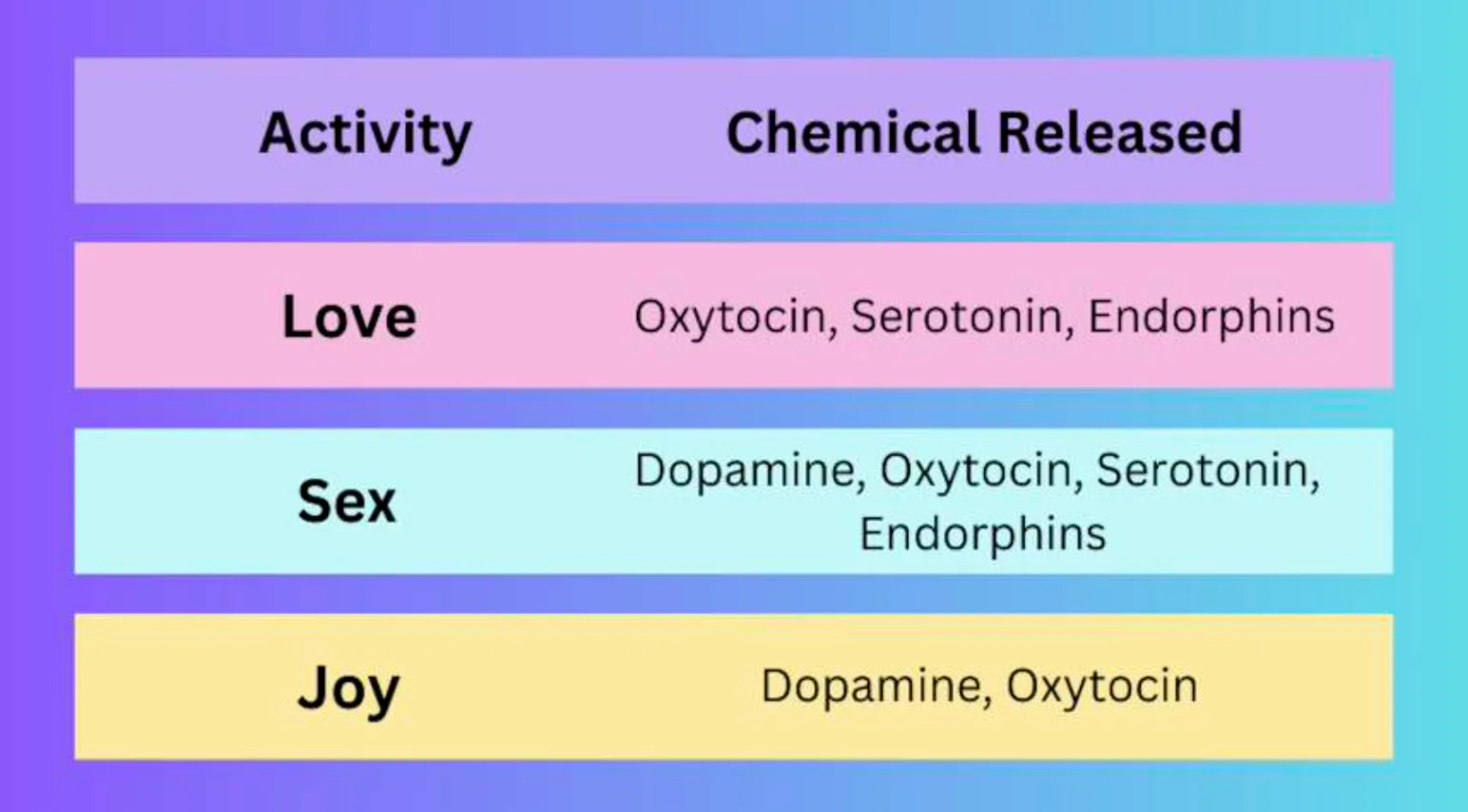
These associations illustrate how the same chemicals participate in different emotional and physical experiences. From an evolutionary perspective, the reward system encourages behaviours associated with survival, connection, and reproduction. Sexual activity, for example, carries powerful chemical incentives that contribute to the continuation of our species.
But the implications extend far beyond survival. We begin assigning value to experiences according to the sensations they produce. Our preferences develop around what feels rewarding, and our behaviour increasingly follows those preferences. We pursue what makes us feel good and avoid what makes us feel uncomfortable. And eventually, we forget that much of this behaviour was learned.
Even Love Has Chemistry
Consider oxytocin, often associated with trust and emotional bonding, it participates in the experiences of a mother nursing her child, partners embracing, intimate touch, kissing, sexual connection, and the affection we share with our animals.
The Greeks recognized different expressions of love, each representing a particular dimension of human connection.
Storge describes familial affection, particularly the natural bond between parents and children.
Eros represents romantic and passionate love.
Philia describes friendship, companionship, and affectionate connection.
Philautia represents love of the Self.
Agape expresses unconditional love.
Each experience carries its own emotional significance, and each can involve different combinations of chemical activity. Our interpretation of love influences how we experience it, while the associated chemical responses reinforce the emotional meaning we assign to that experience.
The relationship between mind, body, and emotion is continuously reinforcing itself. We experience something pleasurable. Our body produces a chemical response. We associate that response with the experience, assign it value, and begin seeking opportunities to repeat it.
In effect, we become addicted to the chemical rewards produced by experiences we've learned to value. We're producing the chemicals, experiencing the sensations, assigning the meaning, and then pursuing the next opportunity to experience the same reward.
Quite an elaborate arrangement for something we're doing to ourselves.
The Chemical Loop
Our emotional experiences are also influenced by chemicals associated with stress, discomfort, and heightened alertness.
Cortisol participates in the body's stress response, while adrenaline and noradrenaline contribute to the heightened physiological states associated with fear, anxiety, and the fight-or-flight response. Within our conditioned experience, we begin categorizing these internal states as desirable or undesirable.
We seek the sensations we've labelled good and resist those we've labelled bad. Over time, our beliefs become part of this reward system. When we encounter information that agrees with our existing beliefs, we may experience satisfaction, reassurance, and a sense of validation. When information challenges those beliefs, we may experience discomfort, defensiveness, or stress.
The mind begins favouring information that reinforces its existing understanding of reality. This is how conditioning protects itself. We develop an attachment to being right because agreement feels rewarding. We resist alternative perspectives because disagreement threatens the familiar emotional state associated with our beliefs.
Eventually, we can become more committed to preserving our conditioned understanding than discovering something new. And all the while, we believe we're thinking independently.
The Emotional Spiral
Our thoughts, emotions, and chemical responses participate in a continuous feedback loop. When we experience a pleasurable emotional state, the associated chemistry can reinforce thoughts and behaviours that sustain that experience. We feel good, think positively, behave accordingly, and create further opportunities to experience rewarding emotions.
The same principle operates when we become caught in fear, frustration, resentment, or anxiety. A stressful thought produces an emotional response. That response influences our interpretation of subsequent events, which can reinforce the original emotional state.
We begin experiencing life through the chemistry of our existing condition. A single event can initiate an emotional spiral that continues long after the event itself has passed.
Consider how easily a disagreement can affect the remainder of our day. One conversation produces frustration, which influences our next interaction, which reinforces the frustration, until we find ourselves responding to circumstances that have little connection to the original event. We may even begin looking for further evidence to justify how we feel. Our conditioning has taken the wheel.
The question is whether we're aware of who's driving.
The Driving Force
When we hear the word addiction, we generally associate it with substances or behaviours that society has identified as problematic. Drugs, alcohol, gambling, pornography, food, and other compulsive activities are familiar examples.
Yet the underlying desire for chemical reward extends throughout ordinary human behaviour. We seek our D.O.S.E. through relationships, accomplishments, recognition, entertainment, possessions, approval, and countless other experiences. Some people become attached to success. Others seek validation, affection, excitement, or the satisfaction of being right.
We may even become addicted to familiar emotional states, including those we consciously claim to dislike. The person who continually finds reasons to be angry may have developed a deeply conditioned relationship with anger. Someone who repeatedly anticipates disappointment may have become accustomed to the chemistry of expectation and anxiety.
The familiarity of an emotional state can become rewarding in its own way. Our conditioned mind develops patterns around the experiences it knows how to reproduce. Within this framework, addiction becomes a useful way to understand our attachment to chemical rewards and the behaviours through which we pursue them.
Abraham Maslow explored human motivation through a hierarchy of needs, beginning with physiological requirements such as food, warmth, and survival. Our chemical reward system participates in satisfying these fundamental needs, encouraging the behaviours associated with maintaining life.
But human awareness allows us to examine the mechanisms driving those behaviours. We can observe our desires without automatically acting upon them. We can recognize an emotional response without allowing it to dictate our next decision. We can question whether the reward we're pursuing genuinely reflects what we want to experience. And we can begin discovering alternative ways to fulfil our needs through connection, awareness, and conscious choice.
Becoming UnPhucked
Once we recognize the relationship between our conditioning, chemical rewards, and automatic behaviour, we can begin examining our own consciousness. We start noticing the patterns that previously operated without our awareness. Why do certain words offend us? Why do we become defensive when someone disagrees with our opinions? Why do we repeatedly seek approval from others? Why do we continue behaviours that no longer serve us? Why do we allow circumstances to determine our emotional state?
Each question creates an opportunity to observe the conditioning behind our responses. As awareness develops, we begin recognizing that our thoughts, emotions, and behaviours are experiences occurring within consciousness. We can observe them, examine them, and consciously choose how we wish to respond.
The primitive mind continues performing its biological functions, while our expanding awareness allows us to engage with those functions differently. We begin shifting from automatic reaction toward conscious participation.
The word sentient describes the capacity to feel, perceive, and experience awareness. Within the philosophy of this book, becoming sentient represents the conscious recognition of our own internal processes and our ability to participate deliberately in the way we experience reality. We begin to recognize that we're far more than the collection of conditioned behaviours we've mistaken for our identity. And at some point in this process, a shift occurs.
We realize that many of the limitations we've accepted were established through beliefs we never consciously chose. We recognize how frequently our behaviour has been directed by emotional rewards, inherited assumptions, and automatic responses. We begin to understand that awareness gives us the opportunity to choose again.
This is the beginning of awakening.
Every conditioned response we recognize offers another opportunity to reclaim our personal power. Every belief we question creates space for a different understanding. Every moment of awareness allows us to reconsider who we believe ourselves to be.
The process begins with a simple willingness to examine ourselves.